A pressure gauge is bought on one number and that number is routinely misunderstood. Accuracy is stated as a share of the full span of the scale rather than of the reading you are taking, so a gauge that covers more range is a less accurate gauge at your pressure. The allowance is also banded across the dial: tightest over the middle half, one point wider in the first and last quarters.
Buy the smallest scale that comfortably reaches your highest pressure. A 250 PSI gauge setting a 32 PSI car tire carries an allowance of several PSI at a reading where one PSI matters, while a 75 PSI gauge at the same grade carries a fraction of that. The gauge picker on this site works the whole calculation for a vehicle class and returns the scale, the target, and what each grade is allowed to be wrong by there.
Sizing the scale to the pressure
What you inflate
Scale that suits it
Why not something larger
Car and light truck
60 to 75 PSI
A 150 PSI scale triples the allowance at 32 PSI
Trailer
100 PSI
Trailer tires run near their maximum, so a 60 PSI gauge cannot read them
Road bicycle
150 to 160 PSI
Nothing smaller reaches 130 PSI, so the scale is forced
Mountain bicycle
60 PSI
Low target pressure means a wide scale eats the whole tolerance budget
The lineup
5 items
Analog: pencil and dial
No batteries, no wake-up delay, and a scale you read yourself.
Smallest stated allowance
ETENWOLF
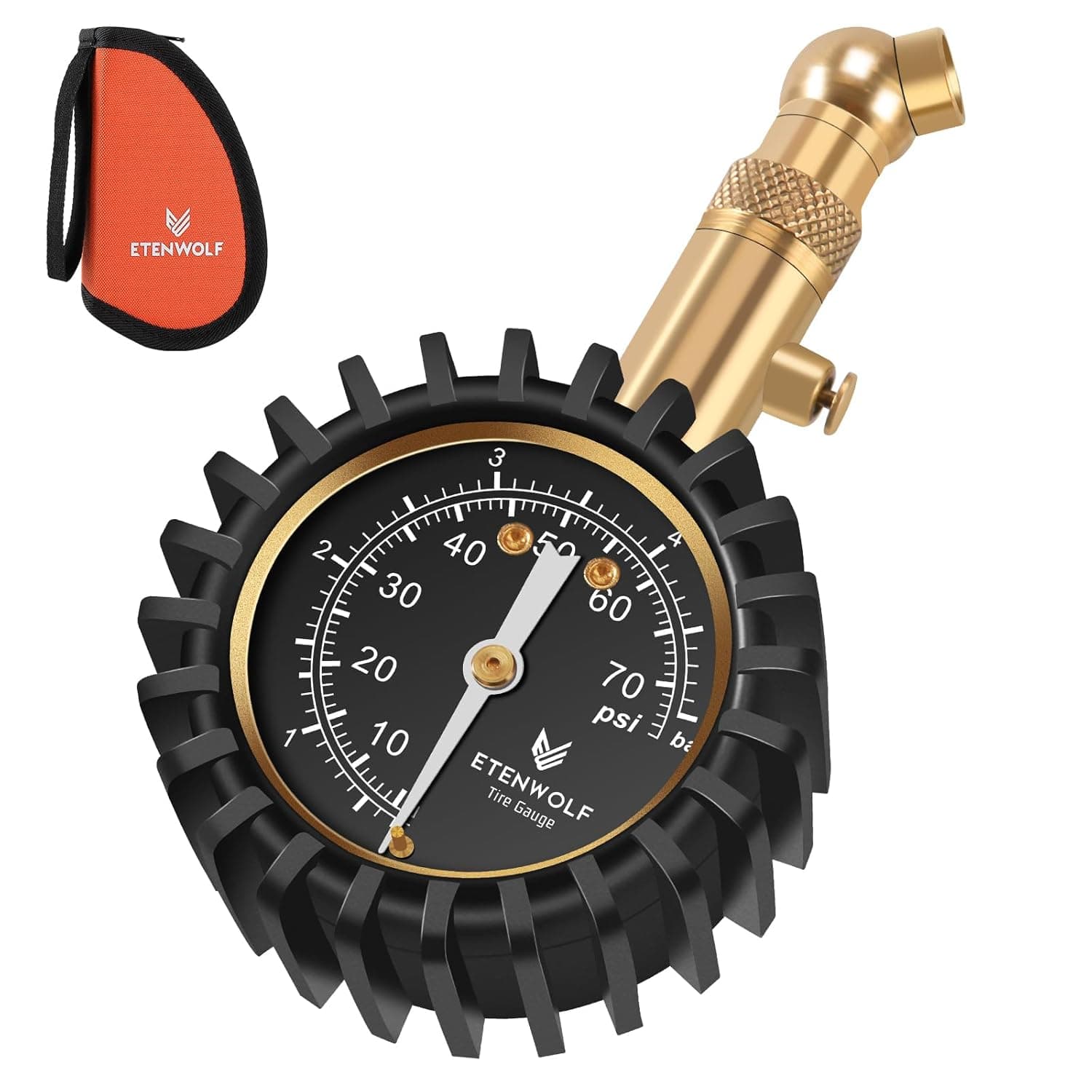
ETENWOLF Dial Tire Gauge, 0-75 PSI
Range
0-75 PSI
Stated grade
B40.1 Grade A (+/- 1%)
Readout
Glow dial
A large glow dial gauge reading 0 to 75 PSI, stated as ANSI B40.1 Grade A at plus or minus 1 percent. Run the arithmetic the gauge accuracy page sets out and 1 percent of a 75 PSI span is 0.75 PSI, the smallest stated allowance of anything in this lineup. For the job this category exists to do, reading pressure accurately enough for the reading to mean something, that is the number that decides it.
The smallest stated allowance here at 0.75 PSI, from the tightest grade on the smallest span
A 75 PSI span keeps car and light truck pressures in the middle half of the dial
A glow dial is readable in a dark garage without a second light
No battery, so it works after a year in a glovebox
Seventy-five PSI will not reach trailer, RV or road bicycle pressures
A dial gauge that has been dropped can read wrong with nothing to show for it
Analog reading means you interpret a needle rather than read a number
Best forCars and light trucks, where the pressures are moderate and the error at your target is what matters.
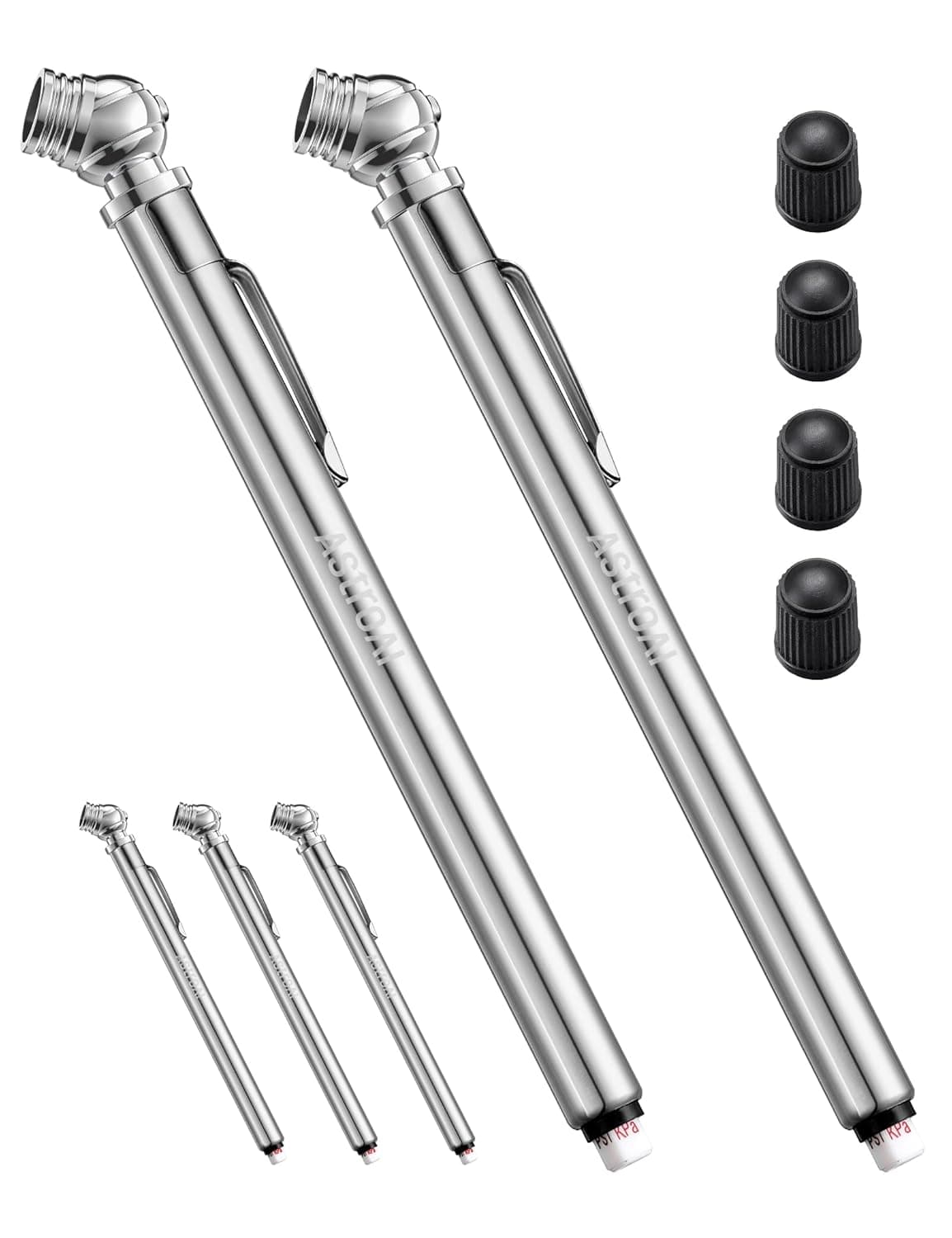
A pair of stainless steel pencil gauges reading 10 to 75 PSI, stated as ANSI B40.1 Grade B at 2 percent, with three measurement scales. Two percent of a 75 PSI span is 1.5 PSI in the middle half of the range. A pencil gauge has no dial to knock out of calibration and no battery, which is why they survive in glove boxes for decades.
Nothing to break: no dial, no battery, no electronics
The 75 PSI span keeps car pressures in the tighter middle band
Stainless body survives a glovebox and a toolbox floor
Sold as a pair, so one lives in each vehicle
A 2 percent grade gives 1.5 PSI, twice the allowance of the Grade A dial here
A sliding scale is harder to read precisely than a dial or a display
Seventy-five PSI does not reach trailer or bicycle pressures
Best forKeeping a gauge in every vehicle, where survival and availability beat the last half PSI.
ETENWOLF Pencil Gauge, 2-pack, 10-50 and 20-120 PSI
Ranges
10-50 and 20-120 PSI
Stated grade
B40.1 Grade B (2%)
Body
Stainless steel
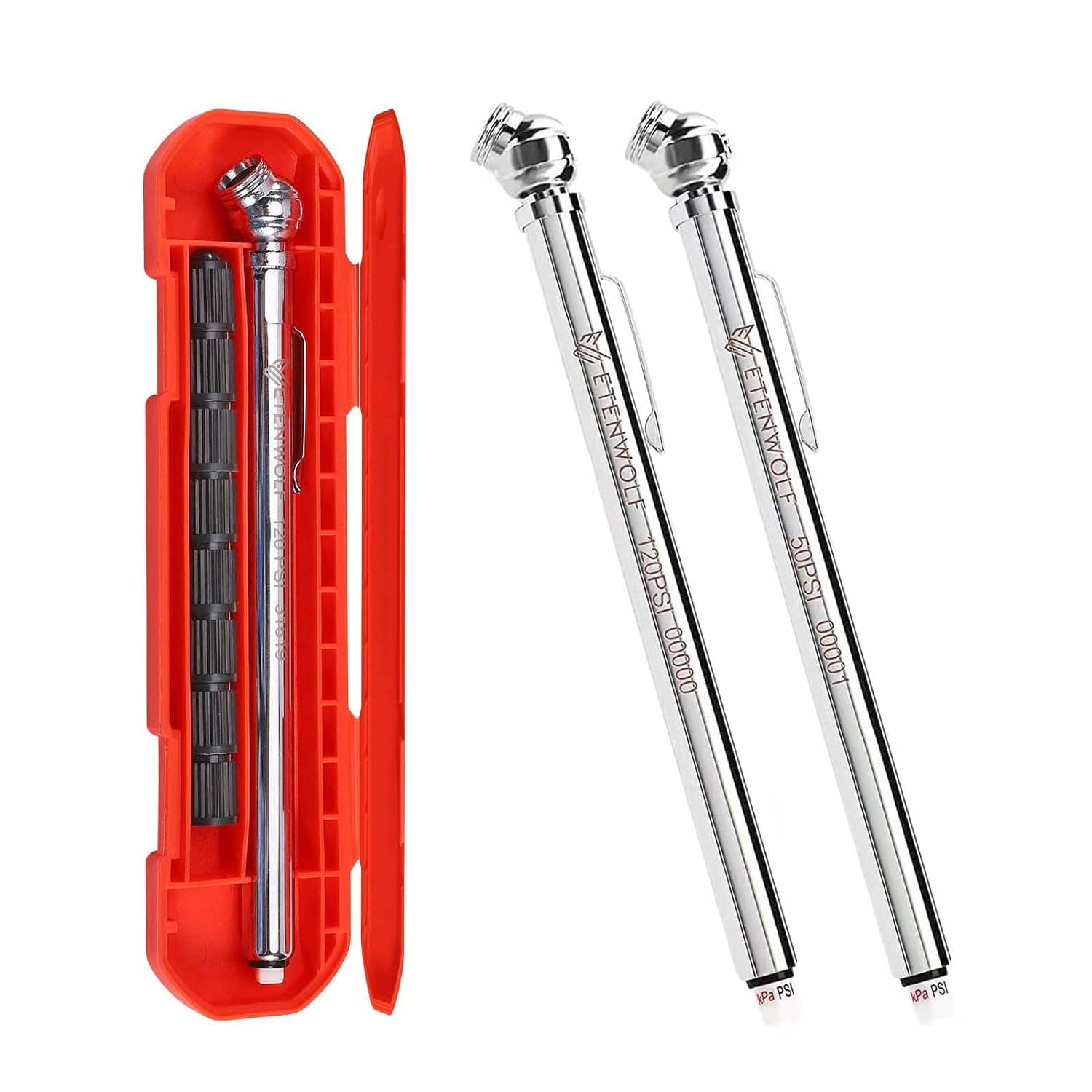
Two stainless steel pencil gauges, one reading 10 to 50 PSI and one 20 to 120 PSI, both stated as ANSI B40.1 Grade B at 2 percent, with 16 valve caps. Splitting the pair across two ranges is the interesting choice: the 50 PSI gauge gives a tighter 1 PSI allowance for car work, while the 120 PSI gauge reaches trailer pressures.
Two different spans, so car and trailer pressures each get a suitable gauge
The 50 PSI unit gives a 1 PSI allowance, better than a single wide-range gauge
The 120 PSI unit reaches trailer pressures that most pocket gauges miss
Sixteen valve caps included, which is the part people lose first
Two gauges means picking the right one before you read, and picking wrong wastes the advantage
Grade B on the 120 PSI unit allows 2.4 PSI in its middle half
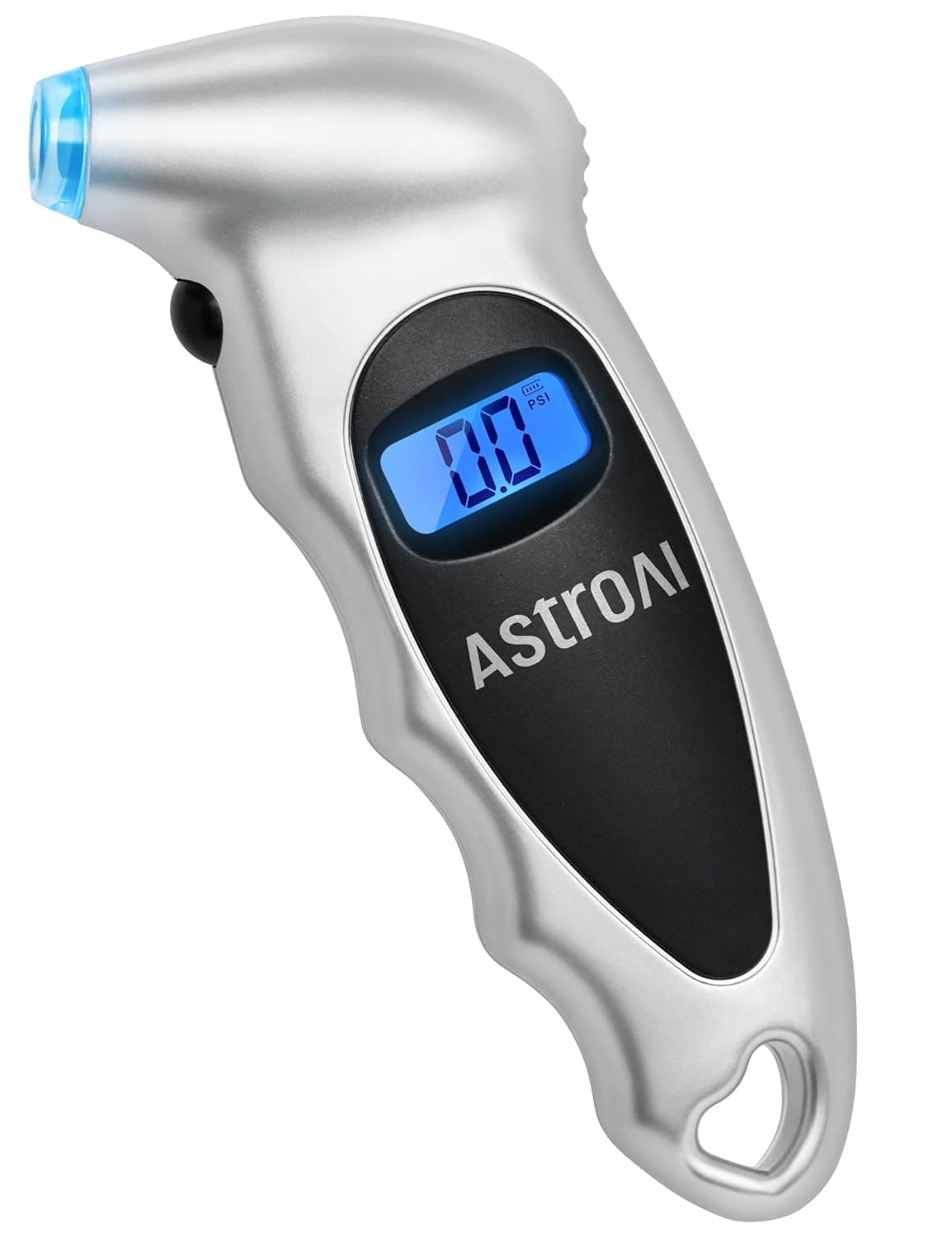
Numeric readout to 0.1 PSI, unit switching, and a battery to keep alive.
Stated in PSI, not percent
AstroAI
AstroAI Digital Tire Gauge, 150 PSI
Full scale
150 PSI
Stated accuracy
+/- 1 PSI
Units
4 settings
A digital gauge reading to 150 PSI, stated at plus or minus 1 PSI and calibrated to ANSI B40.7, with four unit settings. A fixed PSI figure does not map onto the banded percentage grades at all, and that works in its favor here: 1 PSI at any reading beats the 3 PSI a Grade B dial gauge of the same 150 PSI span would be allowed in its outer quarters.
A fixed 1 PSI allowance holds across the whole range rather than scaling with span
A 150 PSI range reaches road bicycle pressures that most car gauges cannot
Four unit settings cover PSI, bar and the metric equivalents without conversion
A digital readout removes the interpretation error of reading a needle
A battery is a failure mode a dial gauge does not have
A fixed PSI figure cannot be compared to a percentage grade without doing the arithmetic
Digital resolution is not accuracy, and a display to 0.5 PSI does not mean the reading is
Best forA household covering cars and bicycles with one gauge, where the pressure range is wide.
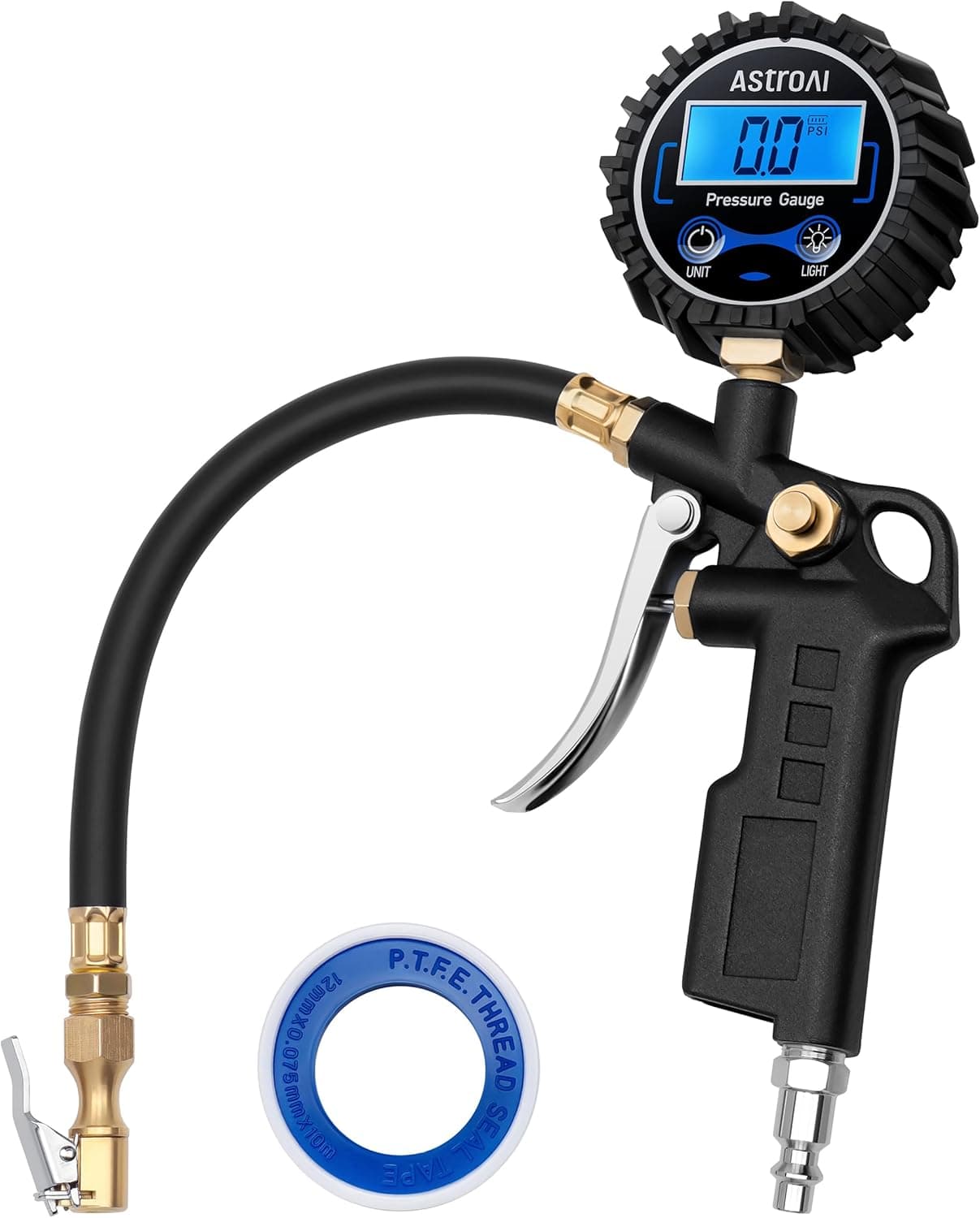
A digital inflator gauge reading 3 to 250 PSI, with a quarter-inch NPT fitting, a quick-connect coupler, a backlit LCD and 0.1 resolution. This is the only item here that puts air in as well as measuring it, which makes it a compressor accessory rather than a pocket gauge. The 250 PSI span is why: it has to survive line pressure, not just tire pressure.
The only item here that inflates as well as reads
A quarter-inch NPT fitting is the standard thread, so it meets ordinary compressor lines
A quick-connect coupler means it comes on and off the line without tools
Backlit display works under a car and in a dark bay
The listing states no accuracy figure at all, in PSI or as a percentage
A 250 PSI span puts car pressures low on the range, which is the worst place to read
Useless without a compressor, so it is not a standalone gauge
Best forA garage with a compressor, where setting pressure and checking it should be one operation.
Range, stated accuracy and what the allowance works out to
Gauge
Range
Stated accuracy
Allowance in PSI
Inflates
ETENWOLF Dial Tire Gauge, 0-75 PSI
0-75 PSI
+/- 1% of span
0.75 PSI
No
AstroAI Digital Tire Gauge, 150 PSI
0-150 PSI
+/- 1 PSI
1.00 PSI
No
AstroAI Digital Gauge with Inflator, 3-250 PSI
3-250 PSI
Not stated
Not stated
Yes
AstroAI Pencil Tire Gauge, 2-pack, 10-75 PSI
10-75 PSI
+/- 2% of span
1.50 PSI
No
ETENWOLF Pencil Gauge, 2-pack, 10-50 and 20-120 PSI
10-120 PSI
+/- 2% of span
2.40 PSI
No
Before you trust this
The sidewall figure is the maximum the tire is permitted to hold, not a target. The number on the vehicle door placard is what sets your pressure.
Read pressure cold. A tire driven even a few miles reads high, and bleeding it down to the placard figure while warm leaves it underinflated once it cools.
A dashboard warning lamp is a late alarm rather than a gauge. Federal rules require it to warn only after a substantial drop below the placard pressure.
A Presta valve needs a head that closes on it. A Schrader-only gauge will not read a road bicycle tire whatever its scale says.
Lifespan and care
A dial gauge that has been dropped can read several PSI out and look perfect. Compare two gauges against each other occasionally; agreement is not proof but disagreement is a finding.
Digital gauges fail by battery, usually in the cold, and usually the first time you need one in January. Keep the vehicle gauge analog if it only gets used in winter.
Pencil gauges survive a glovebox for decades because there is nothing in them to break. That is the whole argument for keeping one in each vehicle.
Grit on the head causes a bad seat and a low reading. Wipe the head and the valve stem before reading, particularly on a wheel that has been through winter salt.
Because the allowance is a share of the span rather than of your reading. Two percent of a 250 PSI scale is 5 PSI at every point on the dial, including at 32 PSI, where 5 PSI is a sixth of what you are trying to set.
What do Grade A and Grade B mean?
They are banded allowances. Grade A is documented as 1 percent of span across the middle half of the dial and 2 percent in the first and last quarters; Grade B is 2 percent and 3 percent. Consumer listings usually quote only the middle-half figure, which is the best case.
How do I compare a digital gauge stated in PSI against a graded dial gauge?
Work the dial gauge allowance out in PSI first, then compare like with like. A digital gauge stated at plus or minus 1 PSI beats a Grade B 150 PSI dial gauge, which is allowed 3 PSI in its middle half.
Is resolution the same as accuracy?
No. Resolution is how finely the display reports, so a gauge showing 0.1 PSI steps can still be 2 PSI wrong. Accuracy is the allowance; resolution is only the granularity of the number you read.